
The Bates Motel – Factory Road Released 23 October 2026 | Badlands Music Inc album review
Reviewed by Allister Spence
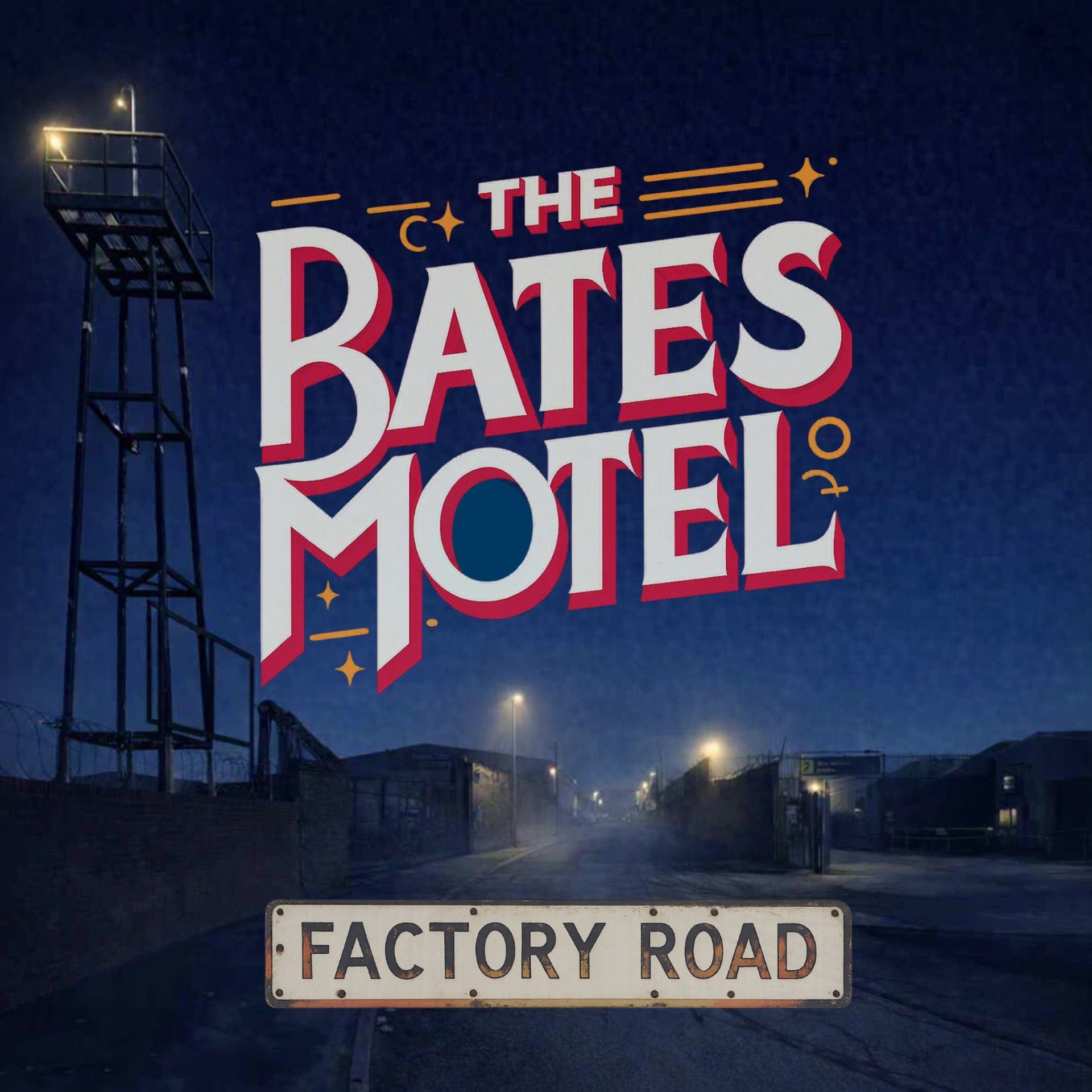
There’s a certain kind of record that doesn’t need to announce what it is. Within seconds, you know. Guitars bite; drums crack, the bass finds your ribcage, and a voice arrives sounding as though it has lived through enough stories to fill several albums. “Factory Road,“ the debut full-length from Geordie rockers The Bates Motel, is one of those records.
Following their four-track “Songs for the Lost and Lonely EP,” “Factory Road” brings together Bad Bob Bates on guitar and lead vocals, Ally Lee on guitars, keyboards, backing vocals and, apparently, Bob heckling; Dave Coates on bass and backing vocals; Adam Forster on drums; and Les Young adding harmonica, percussion and backing vocals. Between them lie decades of performing and recording experience, and it shows. This isn’t a band straining to sound seasoned. They simply are.
Their songs reflect that accumulated mileage, too. Life in The Bates Motel encompasses the good, the bad and the ugly: relationships and regret, friendship and frustration, memories of youth and an increasingly bewildering modern world. Thankfully, they remember that rock ‘n’ roll is also supposed to be fun.
Opener ‘Bloodstains’ makes the point immediately. It’s jagged, guitar-driven rock with more than a hint of prime Dr Feelgood in its bloodstream, the riffing possessing that sharp, economical urgency associated with Wilko Johnson. It’s an energetic opening salvo with just enough menace beneath the surface.
Bad Bob describes it as a stream of thoughts about the state of the world today: paranoia set to music.
‘3 Degrees C’ changes the texture without sacrificing momentum. A strummed acoustic guitar provides an inviting opening before drums and electric guitar muscle their way in and establish an easy, rolling rhythm. Its origins are somewhat less conventional.
Bad Bob told me the idea came from overhearing a couple of guys in the pub talking about the problems caused by moist air in old cars. They reckoned a drier environment would make all the difference. Except it encouraged bugs!
Stranger things have inspired great rock songs!
The title track, ‘Factory Road,’ sounds as though it could hardly have acquired its name anywhere else. Thumping drums underpin a succession of riffs, the whole affair growing organically and picking up something of a glam-rock stomp along the way.
Bad Bob explains that ‘Factory Road’ began as a studio jam. Junkyards and old-school motor-mechanic units surround the studio, which is also close to Bridge Street, the road celebrated in his solo track ‘Bridge Street in the Rain.’ Looking out at the view, he played a few notes. Once the lyrics arrived and the rest of the band joined in, they worked it into the recorded version with help from Ally Lee.
If ‘Factory Road’ reflects the band’s immediate surroundings, ‘Hands On The Radio’ reaches much further back. Previously heard on “Songs for the Lost and Lonely” and remixed for the album by Ally Lees, it’s a cracking rocker about a time when discovering something on the radio could feel momentous. A brief but thrilling guitar solo helps drive the song towards its finale, but the melody is the thing that’ll follow you afterwards. Already a live favourite, it’s easy to hear why.
Bad Bob explained that the song goes back to his childhood and teenage years, and to the way radio helped him through them.
For those who grew up during the ‘60s and ‘70s, that connection needs no explanation. Before streaming, algorithms and instant access to almost every record ever made, radio could be a gateway to another world.
‘Coming Around’ is another fine piece of melodic pop-rock, complete with a terrific guitar solo at its centre. It’s also one of “Factory Road’s” slow burners: good the first time around, considerably better by the fourth or fifth.
Talking about the song, Bad Bob explained that it’s about trying to reach out and genuinely being present when offering somebody support, rather than remaining passive.
‘Keep On Shining,’ meanwhile, has a spring in its step that brings to mind the lighter, more playful side of Dire Straits, particularly the feel of ‘Twisting By The Pool’ and ‘Walk Of Life’ (sorry Chris!). Its message is agreeably straightforward: keep doing what you love.
Then comes ‘Stop The World’, which provides some welcome breathing room without allowing the album’s energy to evaporate. Hypnotic and reflective, it captures a recognisably modern feeling: everything accelerating, technology continually advancing and hostility seemingly everywhere. Sometimes, you’d quite like to step off the ride altogether, disappear off-grid and let the rest of the world carry on without you for a while.
Bad Bob describes it as another song about the state of the world but says it’s also about reconnecting with friends and healing old wounds.
Another of the tracks revisited from “Songs for the Lost and Lonely”, it acquires additional weight in the context of the album.
There’s no mistaking the purpose behind ‘Burned In The Flame.’ Bad Bob’s insistence that there should be no “room for hate”, coupled with the line “Dreams may crack but never break”, gets to the heart of it. This is resistance to division expressed not through empty sloganeering but through resilience: don’t allow fear and hatred to prise people apart; hold your ground, retain some grace and find a way to rebuild.
‘Amador,’ by contrast, initially lets some Californian sunshine through the curtains. A long-established part of the band’s live set and another song remixed from the earlier EP, it ambles along wonderfully, with Les Young’s harmonica particularly effective. Bad Bob appears to be taking the leisurely route to Amador, soaking up the atmosphere.
Then, clouds start to gather.
What initially feels sun-drenched becomes less certain as the song progresses and the relationship at its centre proves rather shakier than expected. It’s a neat shift in mood, and ‘Amador’ is another of those numbers whose charms become more apparent with every return visit.
The long-time live favourite ‘Shape In The Mirror’ takes a darker idea and handles it with surprising affection: Bob promises that even death will not stop him hanging around and watching out for the person he’s left behind. Depending upon your outlook, that is either touching or slightly alarming.
Finally, ‘Remains To Be Seen’ closes the album with its amps turned firmly towards 11. The last of the songs remixed from “Songs for the Lost and Lonely,” it’s also the heaviest cut here, with Forster’s drums and Coates’ bass giving the track an enormous shove from below. Lyrically, distance creates uncertainty as time away from a partner allows doubt to creep in and ideas get inside your head, and you think that there’s somebody else.
And then it’s over.
One of Factory Road’s greatest strengths is just how accurately it captures the grit and energy The Bates Motel brings to their live performances. There isn’t a point at which the album noticeably sags or feels like it’s marking time. Everyone gets room to shine, but nobody appears interested in showing off simply for the sake of it. They’re playing as a band.
We shouldn’t overlook Eddie’s contribution, either. His barks and ruffs surely place him somewhere in the supporting personnel.
Much of that immediacy is also down to Ally Lee’s production. It’s clean and bright without polishing away the rough edges that give The Bates Motel its character. Forster’s drums have real impact. Coates’ bass pumps through the speakers, and the guitars, keyboards, percussion and harmonica have sufficient space to make themselves heard. Above it all sits Bad Bob’s voice, clear but never sanitised, delivering its full grit-and-growl Geordie glory.
Ally Lee and Chris Davison, who goes by Bad Bob Bates, share the songwriting responsibilities, while Davison solely composed ‘Stop The World,’ ‘Amador,’ ‘Shape In The Mirror,’ and ‘Remains To Be Seen.’
The most telling thing about “Factory Road,” though, is that it improves with familiarity. Play it again, and details that slipped past the first time begin to stick. Turn it up, and it gets better still.
If your musical compass points towards Americana, alt-country, blues-rock and good old-fashioned R&B, there is plenty here to investigate. Likewise, anyone with a fondness for the lean attack of Dr Feelgood or the direct, song-first rock ‘n’ roll instincts of Tom Petty and Bruce Springsteen should feel comfortably at home.
But The Bates Motel don’t sound like musicians trying to recreate somebody else’s glory days. The influences provide signposts, not a destination. This is the sound of people with decades of experience putting all of that mileage to use and making music because they plainly still get a kick out of doing it.
And perhaps that’s “Factory Road’s” greatest virtue.
We’re living through an era when studio technology, algorithms and AI are changing the landscape around musicians at bewildering speed. “Factory Road” makes a persuasive case for something reassuringly human: people in a room, playing instruments, responding to one another and turning experience into songs. Technology can make things cleaner, faster and more perfect. But perfection isn’t necessarily where the heart and soul are.
There is no age limit on talent, enthusiasm or the ability to make a bloody good rock ‘n’ roll record.
The Bates Motel have just supplied the evidence.
A big thank you to Chris Davison (Bad Bob Bates) for taking the time to provide his insight into the songs’ origins and meanings.
Through the band’s Bandcamp page, “Factory Road” is available as a digital download, and there’s a limited number available on CD. The Bates Motel’s Bandcamp page: